
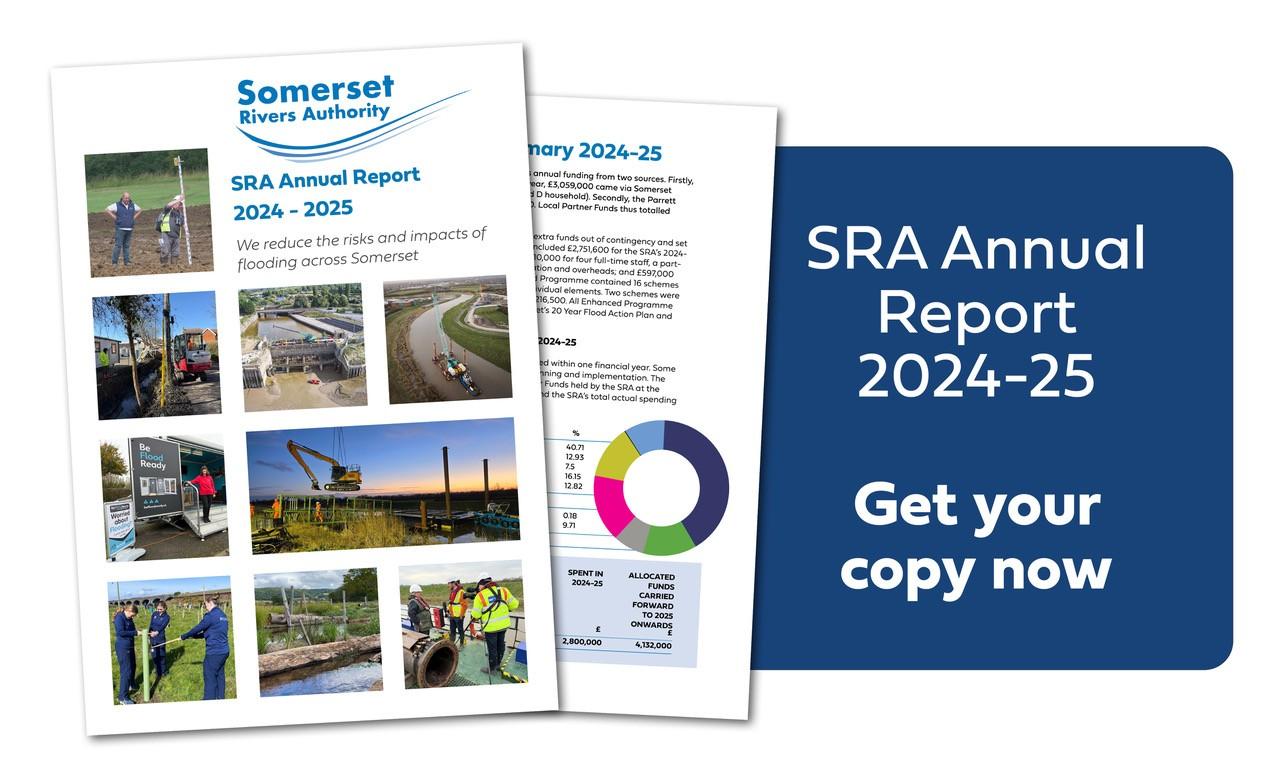
Somerset Rivers Authority Annual Report 2024-25
Somerset Rivers Authority Annual Report 2024-25 TEXT ONLY PDF
Foreword by Councillor Mike Stanton, Chair of Somerset Rivers
Authority (SRA)
I’m pleased to introduce the tenth annual report of Somerset Rivers Authority (SRA).
The SRA is a unique partnership, the only rivers authority in the country. Nowhere
else do partners work quite like we do in Somerset to reduce the risks and impacts of
flooding. This annual report gives you details of what we did in Somerset between
the start of April 2024 and the end of March 2025.
It’s just over ten years since Somerset Rivers Authority was launched as a
partnership on 31 January 2015. The big triggers for the SRA’s creation were the
destructive summer flooding of 2012, then the devastating winter flooding of
2013-14. People living in Somerset, people working in Somerset, people visiting
Somerset, people travelling through Somerset, all wanted more to be done to ‘stop
all this ****** flooding’ – to quote a common sentiment of the time. We have not been
able to stop flooding in Somerset, no one will ever be able to stop flooding in
Somerset, but a decade on, more has been done. More than 260 extra schemes and
activities have been funded through the SRA, that would not otherwise have
happened, and more than £45 million extra has been spent or allocated to ongoing
projects.
What has sustained us? In past decades, Somerset had many post-flood initiatives.
All were for a while enthusiastically pursued, before they ran into the ground like
water into a Mendip swallett… Initiatives like the Parrett Catchment Project which ran
from 2000 to 2007 were good and full of ideas. But they did not last.
In the tenth anniversary year of the SRA, we can reflect upon the reasons for our
relative longevity, beyond our partners’ determination to work together as the SRA:
Somerset Council, the Axe Brue and Parrett Internal Drainage Boards (IDBs), the
Environment Agency, Natural England, Wessex Regional Flood & Coastal
Committee, Wessex Water. A lot is owed to the strength of our original design. We
are properly funded by council tax payers (although the value of that funding is
diminishing each year, as it is not index-linked).
We serve the whole of Somerset, not
just one catchment. We have our own Memorandum of Understanding and
Constitution and public Board meetings where people can come and ask us
questions. There are sometimes awkward questions but that is how it should be. In
January 2025, it pleased us greatly to welcome a delegation visiting from
Lincolnshire to learn more about the SRA. In the dark wet days of 2014, Somerset
looked to Lincolnshire for lessons. It is encouraging to feel that other places now look
to us.
2
You will find in this report much continuity between the SRA ten years ago and now:
dredging, major and minor flood defence improvements, modelling, investigations,
moves to get water off roads and into drains. But there are also some changes of
emphasis. I have become more convinced of the importance of dealing with water as
close as possible to where it lands, especially as flash flooding has become much
more of an issue across Somerset. In January 2025, for example, more than 120
properties were flash-flooded in Chard, Ilminster and South Petherton.
I know from
listening to victims of flooding across Somerset that climate change has sometimes
frighteningly intensified downpours. You will see in this report some measures we
have funded to incentivise people to hold more water back where it falls: these
include natural flood management schemes, planting ‘trees for water’, inspecting
Sustainable Drainage Systems (SuDS), distributing water butts in Chard, and
drawing up climate adaptation plans in the city of Wells and several towns and
villages.
There are increasingly tight financial constraints on what the SRA as a partnership
can achieve. As I said above, we are privileged to have ringfenced funding, but it is
tied to the levels it was in 2016-17, and just over £3million a year goes considerably
less far than it used to. This is one reason why we have increased our efforts to help
you deal with water yourselves as close as possible to where it affects you in
Somerset. Hence, for example, our investment in localised flood warning systems,
grants for training and equipment, workshops about responsibilities and plans, and
our new Community Flood Action Fund.
It has been very heartening to see your responses to initiatives such as this.
Because, underlying everything I have touched upon in this introduction, you, the
people of Somerset, are what sustains the SRA. We are grateful for your continued
support. I trust that you will find this report about our combined activities useful and
informative. If you have any questions or comments, please get in touch.