
Study aims to find the best way of offering cervical screening tests after pregnancy
Doctors at Somerset NHS Foundation Trust are leading an important study into
whether new mothers or birth parents would prefer to have a cervical screening
(smear) test at their six-week postnatal appointment, instead of waiting for 12 weeks.
As part of the study, people taking part would also be offered a urine self-testing for
Human Papillomavirus (HPV), the virus that causes abnormal cells on the cervix,
leading to cervical cancer.
This type of cancer is common in young women and people with a cervix globally,
which led the NHS to set up the National Cervical Screening Programme over 35
years ago to help prevent cervical cancer.
Since its introduction, the number of cases of cervical cancer have halved, but
uptake of screening is at an all-time low, especially in younger women and people
with young children, something that doctors in Somerset have set about trying to
reverse.
The study, called Postnatal Instead of Normally-timed Cervical Screening (or PINCS
for short), aims to find out whether cervical screening six weeks after childbirth is as
accurate and acceptable as at 12 weeks after childbirth.
If proven, it could lead to a major national policy change, which participants in their
previous study, pre-PINCS, told them would be likely improve accessibility and
uptake, and crucially, save many more lives of young people.
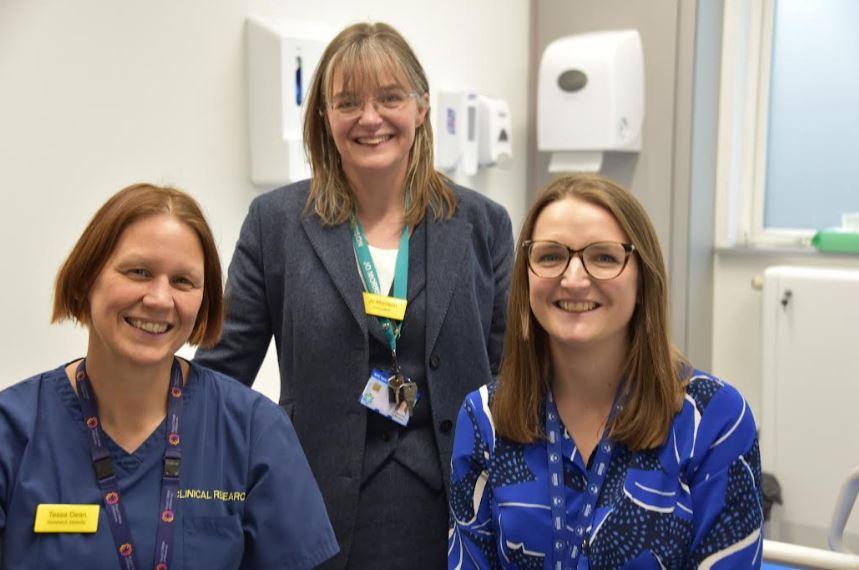
Miss Jo Morrison, a gynaecological oncologist at Somerset NHS Foundation Trust, is
leading the study, alongside Dr Victoria Cullimore, who’s a gynaecological oncology
research fellow and an obstetrics and gynaecology speciality doctor at the trust.
Dr Cullimore explains that the study could have far-reaching effects on the uptake of
cervical screening in the future.
“We know that if a cervical screening test is due in pregnancy, the vast number of
people are told not to have it during this time, and to instead wait until three months
after childbirth, as long as their screening was previously normal and up to date,” she
said.
“In reality, many people who are due at the end of pregnancy tend to forget for many
reasons, including being too busy, getting caught up looking after their baby and
coordinating childcare and GP appointments, which is a challenge.
“Often they don’t have it done until over six months after
their baby is born, which could miss months of time where a cancer could be
prevented or picked up early when it is easily treatable.
“The aim of our study is very much about giving people choice, as 6-weeks may not
be the right time for everyone, but it would be great to give them that opportunity if it
works for them.
“We want to look at offering people an earlier post-natal screening appointment at
about six weeks, because that’s when people generally go for their post-natal check
up with their GP. In fact, over 85% attend that check-up – certainly many more than
who go for their three-month cervical screening test.
“We’re also looking at the acceptability and accuracy of alternative options, such as
offering urine HPV screening, as although it may not pick up as many with high-risk
Human Papilloma Virus (HPV) (the virus that causes cervical pre-cancer and cancer)
as a normal cervical screening test would, it’s still better than having no screening,
and is less invasive.
“In the pre-study we carried out, over two thirds of people said they would be happy
to be involved in the study, and although people didn’t necessarily prefer to have
their screening done at six weeks, they said it would be easier and make them more
likely to get it as it was done at the same time as their other appointment.
“Our PINCS study is currently at an early stage, where we’re trying to work out how
we can best shape a larger national study to answer our question about accuracy.”
The idea for PINCS came from a quality improvement project ran at the trust a few
years ago after colleagues cared for a number of young women who were diagnosed
with cervical cancer, either during pregnancy or shortly afterwards, when they had
missed opportunities to have cervical screening.
“Very sadly some of those women died, and those people and their families really
stay with you,” added Miss Morrison. “That was one of the main reasons I wanted to
make sure we took this work forward in Somerset.
“The initial project was led by Dr Alison Wiggins, another of our gynaecological
oncology consultants when she was a clinical fellow, as well as our former trainees,
Dr Sarah Coleridge and Dr Ellen Nellisen, who are now gynaecological oncology
consultant colleagues at other trusts in the south west.
“As part of this, we improved the screening update by 8% for recently pregnant
women, which is roughly in line with a recent national study that used vaginal self-
screening for non-attenders.
“This study found that people are much more likely to have opportunistic self-
screening when they saw their GP for an unrelated problem, rather than if they were
sent it in the post.”
Miss Morrison explained how the PINCS study will work in
practice. “The first phase, PINCS-1, will involve people coming to us six weeks after
their baby is born, instead of the usual 12 weeks, where they take a urine test using
a special, easy to use, sampler, and then a cervical screening test with either myself,
Dr Cullimore, or one of our colposcopy nurses.
“They then come back for another appointment at 12 weeks, so we can compare the
tests against each other.
“In the first couple of months of the study, we’ve found that people are really keen to
be involved – we’ve been delighted by how positive the reaction has been so far.
“We originally anticipated that recruitment for PINCS-1 might take up to a year, but
it’s looking like it may only six months for this first part of our study, due to the
enthusiasm of our participants. In total, we need 100 people to come for their six-
week appointment before we can close the PINCS-1 study.
“Then we’ll analyse that data, to check that screening at 6-weeks is accurate
enough, before beginning the second phase, which involves randomising people into
two groups to compare screening at 6 or 12 weeks.”
Dr Cullimore added: “After we’ve finished this current PINCS-1 study, we’ll run
PINCS-2, which is the randomised part of the trial, that’ll enable us to test the
different ways of offering cervical screening, including self-sampling with vaginal
swabs, urine tests and conventional cervical screening.
“If successful, it should lead to an even larger study that will hopefully give us the
right level of evidence to question the national screening programme, and whether it
can be changed based on our findings. It’s interesting that current guidance is based
on very limited and outdated evidence, from the type of cervical screening tests that
we haven’t used for well over 20 years in the UK.
“I think it’s amazing that we’re able to punch above our weight in Somerset to run
such a significant study like this, that could make such a major change to the care of
women and people with a cervix across the country.
“We’re eternally grateful to our research department at the trust, who’ve done a
fantastic job and have been really supportive – we wouldn’t have got this far without
their support.”
If you want to join the study, email PINCSStudy@SomersetFT.nhs.uk or research
midwife Tessa Dean (Tessa.Dean@SomersetFT.nhs.uk) who will go through things
in more detail and enrol you.