
Somerset surgeon invents new eco-friendly way to collect urine samples
Anyone who has ever had to take a urine test may be familiar with a little 30ml
plastic urine pot with a red top and a patient sticker on the side, which they’ll have
been asked to urinate into for a sample.
Nick Burns-Cox, a consultant urologist at Somerset NHS Foundation Trust, has
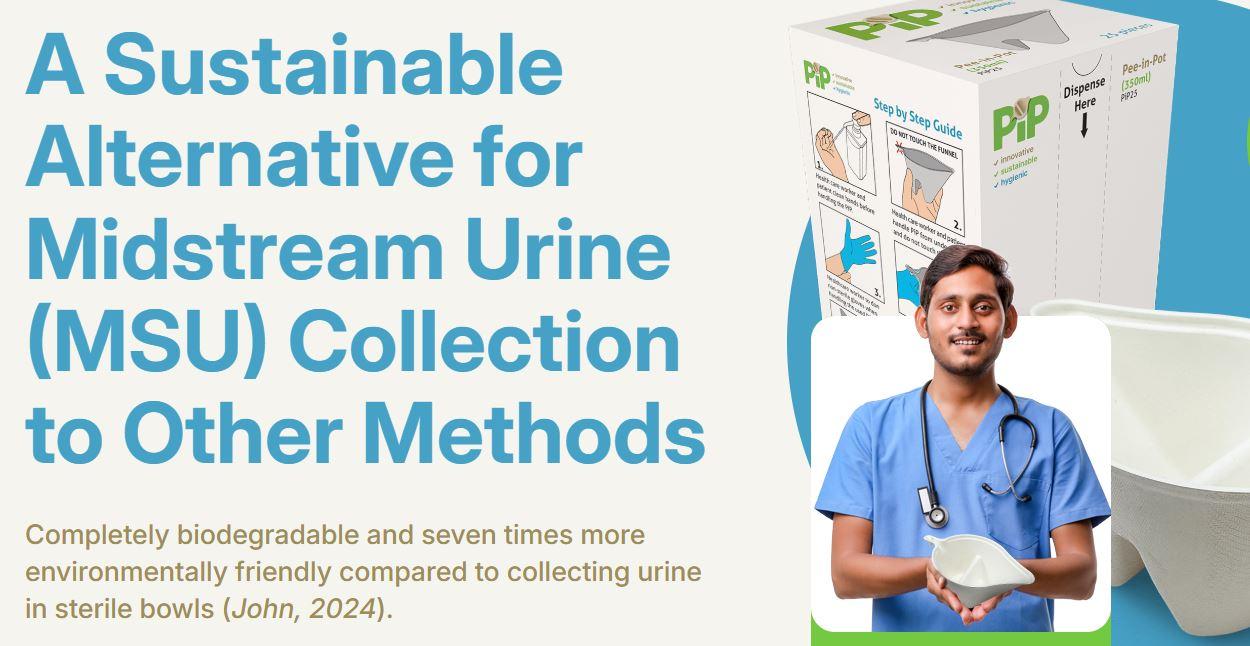
invented a brand new way to collect urine with a ‘Pee in Pot’ (PiP) – made from
biodegradable pulp, rather than plastic.
The innovation, which has taken 10 years of tests, prototypes and studies to get
right, is now available for NHS organisations across the country to start using.
Nick explained how it all began when he was running a clinic in the outpatients
department at Chard Community Hospital, and needed to test a patient’s urine to
check for an infection.
“The ward manager asked me how she was supposed to get a urine sample from a
patient into the 10ml urine collection tube the labs needed, which is about as big as
your finger,” he said.
“In order to get the urine in the 10ml, we were asking patients to urinate in a sterile
bowl, which was syringed into a 30ml tube, sent to the lab, with a laboratory
technician then needing to pipette the urine into a 10ml plastic tube for analysis.
“Looking back at the way we were doing things, it was messy, with many different
colleagues using lots of different containers to get the urine in the right sized pot to
go to the labs, which was very time consuming for colleagues.
“Alongside that, every time we handle a urine specimen we increase the risk of
human error. Whether that comes from mislabelling a sample as we change
containers, or through accidentally introducing contamination. If that happens we
need to repeat the whole process again.
“Not only was it wasting time, but it was wasting materials. Lots of single use plastic
was being used for every collection. I saw the problem and knew we needed to make
something that was fit for purpose and better for our environment.”
Nick worked with his colleagues, talking to a variety of patients, healthcare
assistants, nurses, medics and lab colleagues to see if he could find a solution.
“Seeing the problem made me think there must be an answer for this,” he continued.
“I spoke with my neighbour, Steve Swan, who had the initial idea of a built-in funnel,
which then evolved into the first prototype of the PiP.
“We continued this until we finally had a pot that not only provides a more
sustainable way of collecting urine, but has a series of sections built into it, meaning
that nurses and health care assistants can measure out the 10ml
of urine that they need to get it into the right tube without any other products
needed.”
In the initial stages, Nick investigated what was already being used to collect urine,
and he found many departments across the trust were doing different things, which
made him ask the question of whether the PiP needed to be sterile, or just ‘clean’.
Tracey Doolan, an infection prevention and control nurse at Somerset NHS
Foundation Trust, has been working with Nick for 20 years and has championed the
PiP from an initial trial in just one ward at Musgrove Park Hospital, to helping spread
PiPs across the NHS today.
She explained: “We were really interested in Nick’s innovation from an infection
control point of view, which led to lots of insight into our current practices and made
us question how we do things and whether we could collect urine without needing to
use a ‘sterile’ pot which has much larger CO 2 and costs more too.
“We worked with an academic consultant microbiologist, medical statisticians, a
clinical sustainability fellow, laboratory teams and infection control colleagues to test
our research.
“We found that the PiP was safe to use for collecting urine, and didn’t contaminate
the specimen, meaning it didn’t need to be sterile – a big step forward for us.”
As the PiP is made from white pulp, it can be flushed in a macerator, rather than
plastic, which is incinerated – making it seven times more environmentally friendly,
compared with collecting urine in sterile plastic bowls. Just the reduction in plastic
incineration will save the trust around £300 for every 21,000 sterile bowls previously
used.
Macerators are used across hospitals to break up pulp waste such as bedpans, urine
bottles and sick bowls, which are turned into slurry and go through the sewage
system. The PiP is made from Thermofibre TM , a blend of bamboo fibres and sugar
cane pulp which is formed at high temperatures in clean room conditions.
For every thousand hospital beds, urine needs to be collected around 21,000 times a
year, so the benefits of having a more environmentally-friendly solution are
substantial.
The carbon reduction from not using the plastic equates to about three tonnes a year
across the entire NHS – that’s as much as over six houses electricity use for a year!
Nick continued: “It’s much easier for patients to use, as my friends and family who
have tested my many prototypes can attest to! As it’s got a larger surface area
patients don’t have to struggle, especially when they are unwell or have poor
mobility.
For example at every midwife appointment, we ask patients to do a urine sample and
trying to do this while nine months pregnant is quite a feat!”
For Somerset NHS Foundation Trust, with around 1,000 inpatient
beds across acute, community and mental health sites, just the time saving of a
shorter and easier urine collection process saves about £166,000 a year.
In practice this time can be spent on other patient-facing care tasks and vital
laboratory work, making the health system more efficient.
Nick’s passion for sustainability has shone through this project, from applying to
grants and getting funding from the Small Business Research Initiative (SBRI), to
listening to every colleague involved in urine collection. This has helped to make the
PiP easy to use, by adding a lip to make them simpler to separate from each other,
and making sure they stack efficiently.
He added: “The traditional model for designing products in operating theatres is that
private companies develop, make and sell items, having not lived in our shoes and
experienced our day-to-day problems. But as healthcare professionals, we are in the
perfect position to develop solutions to important clinical problems.
“We are used to the idea and perception that it’s not for NHS colleagues to design
solutions – but it absolutely can be. All the professionals who have helped get this
innovation to completion show what we can achieve by working together.
“With every PiP that finds its way into GPs, clinics, hospitals and wider in the
community, I hope it makes patients and colleagues lives easier, but most
importantly people know that by using a PiP, they are doing their bit for the
environment.”
Visit the PiP’s website to find out more = https://peeinpot.com/