
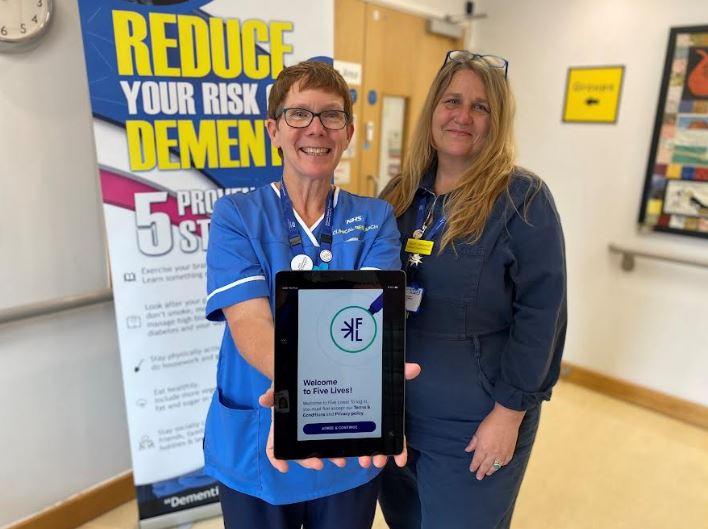
Somerset patients play huge part in study aiming to slow the progress of dementia
Somerset NHS Foundation Trust has joined an international study that’s testing whether patients with a mild cognitive impairment can improve their cognitive function by using a digital health app.
Patients taking part in the Five Lives MED study are being randomised into two
groups – one group receives the app, called Five Lives MED, which they will use
three times a week for 12 weeks.
Those in the other group do not receive the app and will act as a ‘control group’. At
the end of the study, the cognitive function of patients in the two groups will be
compared.
At the beginning of study, patients in both groups undergo comprehensive cognitive
testing, using several current standard methods of testing, in addition to a method of
digital testing.
Patients will answer questionnaires relating to their behaviour, how their cognition
impacts their quality of life, and their knowledge of Alzheimer’s. A study partner will
also provide insight into the participant’s cognitive function.
In total, eight sites are involved in the study – six smaller ones in the UK, including
our trust, and two larger ones in France. The aim is to recruit the same number of
patients from each country.
Tracy Hallows, a clinical trials officer at Somerset NHS Foundation Trust, said: “The
aim of the trial is to see whether people with a clinically diagnosed mild cognitive
impairment can see an improvement in their cognitive functioning by following some
of the mental and physical exercises within the app.
“In addition to brain training ‘games’, the app provides achievable goals and aims to
increase awareness of risk factors associated with cognitive decline, helping the
participant to make positive life choices.”
Once patients have been identified and have consented to take part, the baseline
assessment is completed, before patients are randomised – half to receive the app
for 12 weeks and half to act as controls.
Patients are allocated to different groups using intelligent software to eliminate bias,
ensuring that both groups of patients are comparable. During this period patients
who receive the app are expected to complete a series of assessments (like brain-
training games) at least three times a week.
“Our target is to recruit 15 patients, but we are able to over
recruit, which is really positive,” continued Tracy. “This is a commercial study, and
therefore, each patient brings money into the NHS.
“Recruitment is competitive across the six UK sites and so the race is on to get our
numbers as quickly as possible.
“At the time of writing, 11 patients have been recruited, though we are blinded to how
many of these have received the app. The reason for this is so that when we perform
the cognitive assessments at 12-weeks we are not biased.”
Five Lives is a small French start-up company that has already developed an app to
promote brain health for older adults who may be at elevated risk for cognitive
decline. It’s available for free in the UK in both Google and Apple app stores.
Tracy continued: “The app in this study is the first version of a second app developed
by the company for use by patients who have a diagnosis of mild cognitive
impairment, and that’s where the NHS comes in as we’re best placed to identify
patients in the early stages of the condition who would benefit in taking part.
“Research is considered very important within our trust, and evidence suggests that
hospitals with a high research component also have improved patient outcomes.
“With the help of Dr Adrian Hayes, one of our consultant psychotherapists, who
received funding as a research associate from the National Institute for Health and
Care Research, we have raised awareness of research in mental health and
dementia over the past two years.”
Tracy explained the important role that clinicians across the trust are playing in
finding suitable patients for the trial.
“For this study in particular, we have offered our clinicians an opportunity to get
involved in the research delivery process, and we’ve hopefully removed some of the
unknowns and barriers associated with research.
“Our clinicians identify patients with cognitive impairment, and then our research
team screens them for initial eligibility, before contacting suitable patients to have a
more in-depth conversation, as there are a range of criteria they must meet to take
part.
“Once this has been completed, and the patient is fully informed and happy to move
forward, a baseline assessment is arranged.
“We are flexible in terms of where we conduct the assessments, inviting the patient
into Musgrove Park or Yeovil hospitals, their closest community hospital or in their
own home if they are unable to make the journey.
“The baseline assessment, which takes about two hours, includes three cognitive
assessments, questionnaires and a knowledge quiz about Alzheimer’s, to find out
how much they know already about the condition.
“The majority of our patients are very concerned about progression to dementia and
reassurance is provided during the assessment that this prognosis is not
predetermined.
“We also ask them to do a light physical challenge, and then at the end of the
appointment, we randomise them using the computer software to either receive the
app…or not.
“Those randomised to not receive the app are provided with information about how
to best maintain their cognitive health. If they are randomised to receive the
intervention, we help them install on their phone, show them how it works, and ask
them to use it.
“We ask that they use the app three times a week for at least half an hour,
completing at least one full session a week. If the patient is not using the app as they
should, we do receive notification from the study team and contact the patient to
support their involvement.
“After 12 weeks we invite all patients in both groups back and carry out a repeat
assessment, with the clinician doing the assessment unaware of whether the patient
has the app or not, so that they remain unbiased.”
Following this assessment, all patients are offered access to the app for six months,
so they can either continue using it, or start using it and see how they get on. Their
activity during this time is not monitored as closely but is important for gaining
information on use of the app in a ‘real world’ setting.
Tracy continues: “Six months later we do a short cognitive test over the phone, and
this information is analysed to understand the longevity of any impact on cognitive
function. This could be whether there was any improvement, if that improvement was
maintained, or whether the app should be continued in the longer term.
“Our main barrier to recruitment is finding patients with suitable technology and
technical ability to provide comprehensive data. However, all data is extremely
valuable as you can have the best treatment/intervention in the world, but if a patient
can’t use it or access it independently, then it’s worthless!
“People with mild cognitive impairment are naturally worried about it progressing to
dementia, so they tend to be very willing to try something that might make a
difference,” continues Tracy.
“We find that a lot of the patients who are involved in trials just want to help find a
cure, as they know what an awful disease it is.
“A ‘by-product’ of taking part in research, is that it gives patients another opportunity
to talk and have their anxieties heard. As part of the Five Lives MED study, every
patient must have a ‘study partner’, a loved one or friend, who will support them
through the process. The study also offers them both an opportunity to discuss their
concerns and frustrations.
“Offering research in this area is massively interesting and immensely rewarding.
You get a fascinating insight into the lives of our patients and their everyday
challenges.”
Sarah Oakwood, an advanced practitioner and mental health nurse at Somerset
NHS Foundation Trust, who’s also the study’s principal investigator for the trust, said
she feels very fortunate to be involved in this research.
“Research is one of the four key pillars of advanced practice and it was a great
opportunity to apply that and work alongside Tracy, Ali and Adrian,” she said.
“My background has been within older adults’ mental health and dementia, so to be
able to highlight the profile of people living with cognitive impairment is really
important.
“This study is also working alongside the message that we are trying to promote as a
service of the ways in which you can reduce the risk of developing dementia. Such
as reducing cardiovascular risks and being more active, both physically and
mentally.”
Dr Adrian Hayes, a consultant psychotherapist at Somerset NHS Foundation Trust,
added: “The Five Lives MED project has been very successful in Somerset and has
given us the opportunity to provide lots of clinicians with their first experience of
research.
“It has been great to see the enthusiasm from our participants and their families,
giving up their time to try and extend our understanding of dementia and how it could
be prevented. The team has worked so hard in making the project happen and I’m
very proud!”