
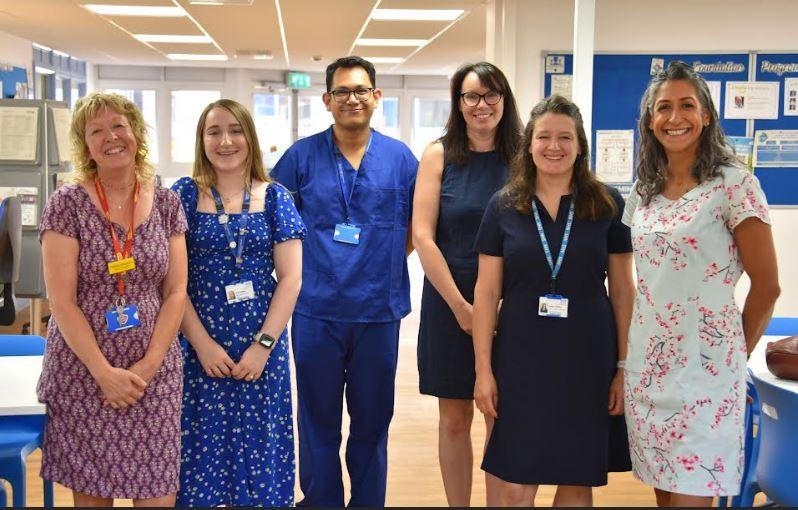
Somerset endometriosis service celebrates two years of accreditation
It was smiles all round for a team of colleagues who care for patients with
endometriosis, as Somerset NHS Foundation Trust has been reaccredited as a
nationally recognised Endometriosis Centre for the second year running.
Endometriosis is a condition that affects 1 in 10 women or those assigned female at
birth of childbearing age.
The inflammatory condition produces cells that mimic the tissue, and present in the
lining of the womb. It can then grow elsewhere in the body – most commonly in the
pelvis.
As well as being found in areas such as the uterus, tubes and ovaries, endometriosis
can also affect other organs in the pelvis, such as the bladder and bowel.
Symptoms vary, but the most common include pain in the lower tummy or
back/pelvis, fatigue, nausea, heavy periods, and problems with infertility. There is no
cure for the condition, so for those diagnosed, they could be cared for by the NHS for
most of their lives.
While it affects over 1.5 million people in the UK, many people don’t know what
endometriosis is, and the huge impact it has on the lives of those who live with it.
Hayley Waghorn is Somerset NHS Foundation Trust’s endometriosis nurse
specialist, and said she’s very proud of everyone in the team for their efforts to get
the trust reaccredited as an Endometriosis Centre for the second year running.
She said: “It has been a long process, as we were an accredited centre before I
joined the trust in 2019, but we lost our status when the service understandably
became limited during the COVID-19 pandemic.
“With a reduction of planned operations taking place during the pandemic, I had the
pleasure of working with our gynaecological oncology service.
“Nearing the end of the pandemic, I was able to focus again solely on the
endometriosis service, and we were able to regroup in order to focus on gaining
back the accreditation.
“I decided to explore what services we have available in the trust for patients in
terms of pain, pelvic health physiotherapy, and nutritional support. The latter is so
important for patients with endometriosis, and this was the final aspect we needed to
offer to become a holistic Endometriosis Centre.
“It is important to make sure that surgery wasn’t the main
emphasis, but instead just one part of the patient’s care. That’s because not every
patient has or even wants surgery, so looking at the patient holistically is essential.
“Also, if the patient can address other health issues they may be experiencing with
some good advice and signposting, this can be quite empowering for them.
Endometriosis often leaves the patient feeling like they don’t know which way to turn,
and they often feel unheard.
“Endometriosis is a whole-body disease, so it’s important that as a service, we’re
offering a really holistic approach to care.
“Most of the feedback I’ve had from patients is they have felt well supported and
listened to by the team, which is very encouraging for us. We can’t always get it
right, but we listen to our patients to make sure we are working to find out what is
troubling them the most.
“I also work as a surgical first assistant, so those patients who need surgery will have
initially spoken to me. This provides a continuity of care for the patients, as I’ll see
them before and after their operation…I have known some of my patients for well
over a year, and sometimes more!”
Hayley works alongside a team of specialists at Somerset NHS Foundation Trust,
including consultant obstetrician and gynaecologist, Balpreet Attilia, consultant
urologist, Andrea Cannon, and consultant colorectal surgeon, Shelly Griffiths, as well
as teams such as the trust’s pelvic health physiotherapy team, led by Debbie Dillon,
and the trust’s pain team.
She continued: “We also have recently forged links with our partners at the Somerset
Sports Activity Partnership (SASP). This team of amazing health coaches have set
up a six week activity and nutrition programme for endometriosis patients, to support
then to return to exercise and help with nutrition.
“The team also works alongside consultant radiologists, meeting monthly to discuss
the more complex patients who come into the service. These patients need more
thorough discussion and investigation, before decisions are made to proceed to any
surgery.
“It’s also important to share that while we have an endometriosis service, and we
continue to hold Centre status, the team who work on this service are also all
providing care elsewhere across the trust.”