
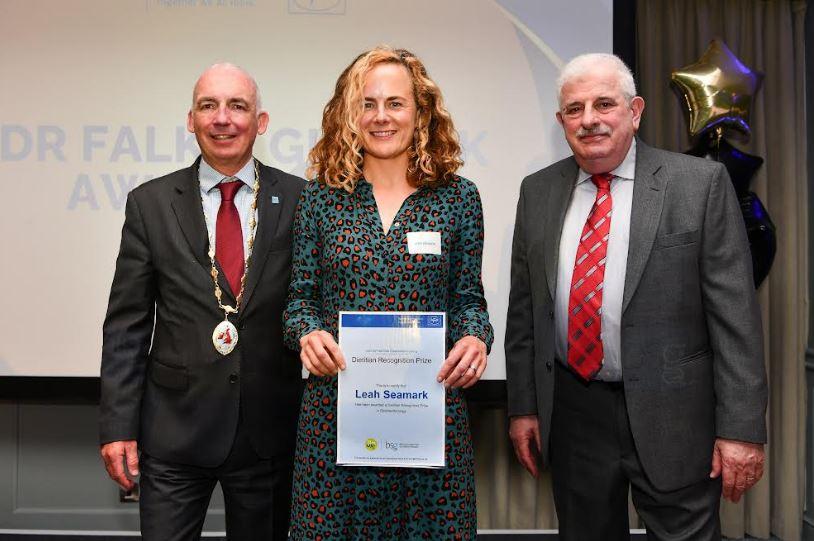
Somerset dietitian Leah Seamark carries off prestigious national award
It’s celebrations all round as one a Somerset community dietitian has gained a top
prize in the prestigious 2024 Dr Falk Pharma/Guts UK Charity national awards held
in Birmingham.
Leah Seamark, who has led Somerset NHS Foundation Trust’s community dietetic
gastro service for almost five years, won the Dietitian Recognition Prize, on behalf of
her team, for their work in giving dietary advice to patients with a wide range of gut
conditions including irritable bowel syndrome (IBS) and coeliac disease – all via
series of webinars and a website.
Leah was thrilled to have won the award, which is jointly run by Guts UK, the charity
for digestive conditions in the UK, and Dr Falk Pharma UK, a pharmaceutical
company that develops medications for digestive and metabolic diseases.
The awards, which are now in their 19th year, reward medical students, trainee
doctors, dietitians, nurses and pharmacists working within GI and hepatology. The
dietitian award recognises innovative work that improves the care of patients with
digestive conditions.
Leah said: “I’m really proud to have won this award as in Somerset our track record
with providing innovative dietetic interventions for IBS is great, as we established the
first UK dietetic-led primary care gastroenterology clinic back in 2011, which was led
by former dietetic colleague Marianne Williams.
“I knew a few dietitians who had won this award in the past, but I had completely
forgotten about this until a colleague from Roehampton University, who we were
collaborating with on a service evaluation, reminded me of it – they felt it met a lot of
the awards criteria.
“This project has been ongoing since 2014, beginning with the development of a
webinar aimed at patients with IBS.
“Our dietitians and gastroenterologists, as well as our GP colleagues, were seeing a
lot of patients in clinic with IBS, and they’d in effect be given the same dietary advice
in various clinic appointments.
“We therefore changed the way we gave this advice and began to ask patients to
watch the webinar first, and if it didn’t work, then they could come back to us for
more specialist dietetic input where needed.
“That’s very much where it all began – a single live webinar running one evening a
month. We had some really good feedback about this, as our patients felt it was a
really useful tool, and we were then able to develop similar
on-demand webinars for coeliac disease, constipation, and a wide range of other gut
conditions.”
As the webinars grew more popular, so did the demand for Leah and her team to
send out all the different links.
“As our admin increased in sending patients specific links to all these different
webinars, we felt that we needed a platform to store them that we could also quickly
update ourselves as and when we needed to,” she continued.
“That’s where the idea of a specific website came from, and back in 2018 one of our
dietitians at the time, Lesley Harper, created a basic website from scratch…but we
found that the traffic going through it started to increase to huge levels, not just
patients in Somerset, but those outside the county too.
“We got some funding to update the website and ensure it was in line with NHS
accessibility, with a company called The Ideas Bureau helping us with the redesign.
“The website launch actually coincided with the beginning of the pandemic, so when
all of a sudden we weren’t able to see our patients for their routine appointments
face-to-face, we had this excellent resource literally ready to go – in fact we had
around 30,000 patients across the country using it!
“It meant that we were still able to direct our patients to some dietetic evidence-
based information, even if we hadn’t seen them to start off with – it was a great
alternative during that period of time.
“Over the years we’ve added more and more webinars on the system, and each time
we develop a new webinar we try to evaluate whether it’s helpful or not. To achieve
this, we have pre and post-webinar questionnaires that we ask patients to fill in,
which helps us to find out their change in knowledge, behaviours and confidence –
all really important.”
Leah added that she feels the team didn’t win the award for just one element of the
project, but instead for the combination of the patient webinar and platform to host
them, as well as the evaluations that support the effectiveness of them.
“It was absolutely fantastic to hear that we’d won the award and it’s very much for
the whole community gastro dietetic team, which have all contributed to the various
projects,” she says.
“We’re always pushing the boundaries and looking at new ways of providing care
and the patient webinars was one of those things which we knew would be helpful,
but this is the first time we’ve had that national recognition of the benefits of all those
parts put together.
“Our department even got £1,000 as part of the awards, which was very welcome,
and this will go into a pot for continuing professional development and further
webinar developments. We were also invited to an awards
ceremony that was hosted as part of the British Society of Gastroenterology annual
conference.
“There have been so many people involved in this, not just our dietetics department,
but we’ve also linked in with our gastroenterologists at Musgrove Park and Yeovil
hospitals, as well as a group of MSc students in Leeds and Roehampton who, as
part of their dissertations, have analysed the data for us so that we can publish the
reports.
“Those links make such a big difference because, as clinicians, our time is limited so
although we can put things in place to collect all the data, actually having the time to
sit down and analyse it is really difficult. Making those links with MSc students and
professors has been really helpful and has benefited the effectiveness of it so much.”