
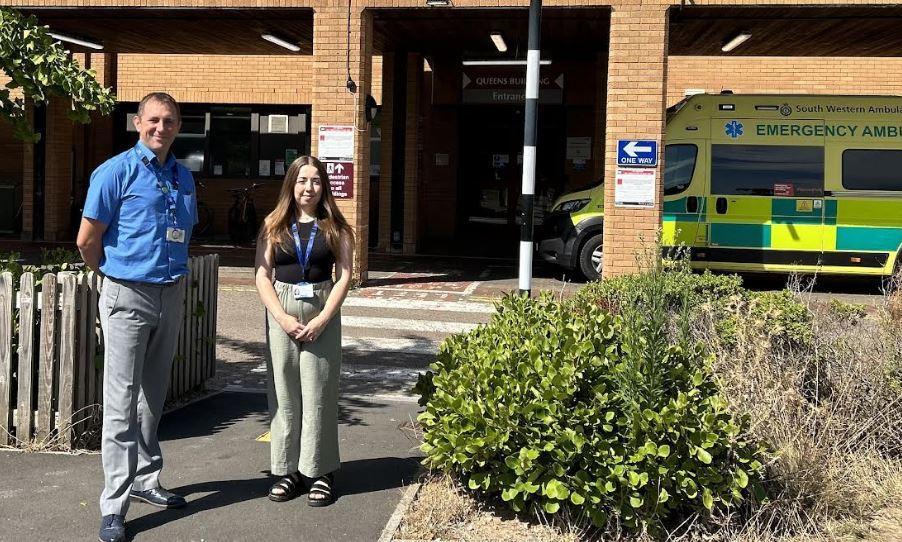
New service results in huge fall in frequent users of Somerset’s A&Es
People who regularly attend Somerset’s emergency departments are getting additional help to find services that can better meet their needs. This is all thanks to a high intensity use (HIU) service, which was set up by Somerset NHS Foundation Trust in August 2023 to monitor and provide support to those patients who frequently use A&E, helping to identify the unmet need and get people the right care in the right place.
The service has proven successful in its first year, with the number of attendances by this cohort of patients dropping by 58% in the first nine months. Since it launched, the service has supported a total of 141 people, who previously had 1,963 A&E attendances between them. Following the HIU service’s involvement, their attendances fell to 1,189 – a reduction of 48% across all ages. The national standard (NHS Right Care) suggests aiming to make a 20 to 40% reduction, and the service in Somerset is comfortably achieving that in just its first year.
Neil Thomas, Somerset NHS Foundation Trust’s high intensity use service lead,
explained: “Research shows that there’s a clear link between a high intensity use of
emergency services and wider health inequalities, such as age, housing instability,
social isolation, loneliness, deprivation, as well as poor physical and mental health.
“This is why we’ve taken care to ensure that our high intensity use service has been
designed and developed alongside people who have lived experience of accessing
healthcare regularly.
“A very small percentage of patients account for 16% of all emergency department
attendances in Somerset, as well as 26% of hospital admissions, and 29% of those
brought to hospital by ambulance.
“Our service is helping us to identify those people who are our top attenders, so we
can find out about their unmet needs in the community, and what we’re not getting
right for them.”
The high intensity use service first came about when a group of clinicians, from
Somerset NHS Foundation Trust’s psychiatric liaison teams and emergency
departments, came together with patients with experience of high intensity use, to
look in more depth at who our frequent attenders are.
“We worked closely with our colleagues at the NHS Somerset Integrated Care Board
to set up three separate high intensity use committees,” Neil added.
“These are in the east and west of Somerset to represent the emergency
departments at Musgrove Park and Yeovil hospitals, as well as the first ever high
intensity use service for under 18s in the country.
“We set up a full data reading system across both emergency departments, so
anyone identified as attending at least 10 times in three months, are now discussed
at our committee meetings, which are attended by a range of clinicians and non-
clinicians from different agencies.
“Depending on the patient’s needs, we may then ask our colleagues at Ubuntu,
which is run by the Community Council for Somerset to find non-healthcare
alternatives for people, to create a non-clinical approach at pace, pulling together
services and thinking differently around the individual’s needs.
“Ultimately this digs deeper into the unknown needs for the individual in the
community, and it ideally brings them a better quality of life, as well as reducing
pressures on our frontline services.
“It’s very much about understanding the little things that matter so much to people,
like somebody needing a ramp built up to their front door because they have
significant pain that means they can’t use steps, and that was causing them to fall,
which in turn caused them to phone for an ambulance.
“Other examples include how a young woman on the neurodiverse spectrum was
scared of the dark, and ended up calling the police and ambulance multiple times
during the winter because she was getting home in the dark – and was scared to go
inside.
“The Ubuntu team got her a timer plug on a lamp, so at 5pm the lamp went on. It can
be those things that may seem very simple to others, but can make all the difference
to those people.
“From this insight, we can develop personalised support plans that are shared
across all of our medical and emergency systems, ensuring that the patient has a
voice throughout.”
The high intensity use service can also quickly spot trends, so the team can start to
see things developing, for instance, if there’s a spike in under 18s with a history of
self-injury.
“We can also see first hand where our patients are coming from,” Neil continued.
“This means we can work with our colleagues at NHS Somerset to understand why
we’re seeing a disproportionate number of patients coming from a particular area,
and whether any wider action can be taken.
“A good example of this is how we’ve noticed that there’s a difference in frequent
attenders to our emergency department by gender, with women tending to come to
ED in their late teens and early 20s, whereas for men it’s those between the age of
30 and 50.
“This has helped us to identify that we have a high proportion of men between those
ages who aren’t getting the help they need. We use this information to inform the
healthcare commissioning teams when they make decisions about planning care.
“We never fully discharge a patient from our high intensity use service, but if they’re
no longer meeting the threshold because they’re getting their needs better met
elsewhere, then we’ll stop talking about them at our committee meetings – which is
ultimately a huge success!”