
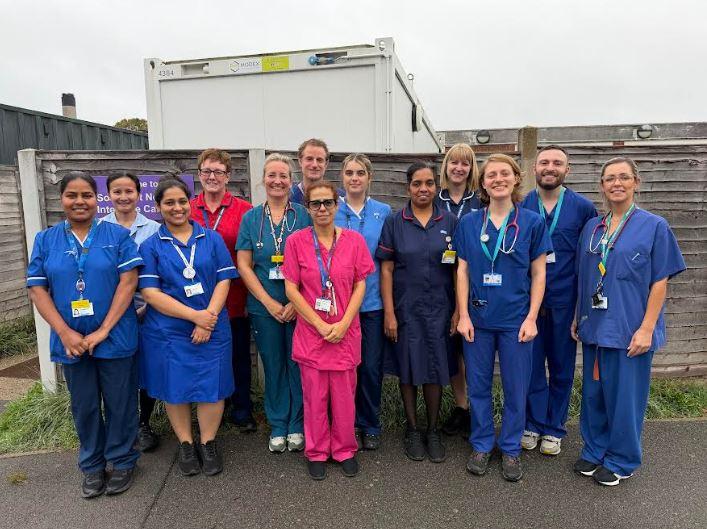
Musgrove Park team celebrates runners-up spot at neonatal care awards
It’s smiles all round for colleagues on the Somerset Neonatal Intensive Care Unit at
Musgrove Park Hospital, after they reached the finals at the national Neonatal
Nurses Association Awards.
The team was shortlisted for Neonatal Team of the Year 2025, for the work they've
done to help parents safely return home with their babies up to five days earlier than
before.
Some babies who would previously have needed to stay in hospital for up to seven
days receiving antibiotics through a drip, are now able to return home after as little
as 48 hours, with a course of oral antibiotics that can safely be taken at home.
Ana Barbosa, an advanced neonatal nurse practitioner at Somerset NHS Foundation
Trust, said: “Since we began this project in February, we identified 19 babies in the
first six months who were suitable to go onto oral antibiotics at home.
“This has freed up 86 bed days over six months – which in real terms means about
one neonatal hospital bed every two days.
“We followed international studies that show oral antibiotics are as effective as IV
antibiotics.
“In total we ran 76 virtual consultations in five months and there were no
readmissions to our emergency departments or paediatric assessment unit, which is
a real marker of success – AND great news for families.”
Ana explained how the decision is made to include a baby in the project. “When
babies are born with risk factors or the mum has maternal sepsis, our usual process
involves using a calculator, called Kaiser, which works out the risk of infection to a
baby,” she said.
“We screen the baby if the Kaiser recommends us to, or if the baby if symptomatic,
and all babies screened for sepsis are put on a minimum 36 hour course of
antibiotics.
“We take the baby’s blood when we first screen them, and again after 24 hours, to
check their C-reactive protein (CRP) levels — a marker that helps us understand if
there’s inflammation or infection. If the CRP levels are negative, blood cultures at 36
hours are negative, and the baby is clinically well, we can stop the antibiotics
altogether.
“If the CRP is raised, the blood cultures come back
positive, or the baby is clinically unwell, we would consider further investigations and
administer a minimum of seven day course of antibiotics.
“But for these babies where the CRPs are raised (between 15 and 50), but they are
clinically well, they meet the criteria to be able to complete their course of antibiotics
at home, instead of having to stay in hospital for seven days.
“Those babies will have their first 36-48 hours of IV antibiotics in hospital, before
completing a further five days of oral antibiotics at home.”
Ana added that one of the main reasons the team undertook the project was to
improve the bonding experience between baby and family.
“Taking a baby home for the first time is one of the most precious moments a family
can ever have, and to be able to do this sooner is so great,” she said.
“Once the baby is home, our consultant will have an initial video call with the parents
to visually check that the antibiotics are working well, and they’ll keep in touch daily.
“We also send them home with a thermometer, so the parents can check their baby’s
temperature once a day while on a call with the consultant.
“We then bring the baby and family back into hospital on the last day of their course
of antibiotics for a formal clinical review, where we repeat the bloods again to make
sure that the CRP is coming down nicely, and the baby is still clinically well.
“On the day of the clinical review, we also ask parents to return any remaining
medication so we can safely dispose of it — and even recycle the plastic caps.
Ana added that everyone on the neonatal unit is so thrilled to get such recognition.
“The awards shortlist acknowledges our team's incredible efforts to improve the
neonatal experience for colleagues, babies, and families,” she said.
“It all came about after our neonatal team submitted a poster to the Neonatal Nurses
Association’s annual conference about this work, and they were promptly invited to
give a presentation to spread the word of their good work to other areas of the
country.
“While preparing our presentation, I noticed the awards so I nominated our team,
and to our delight we were named as finalists. It was so exciting and a real honour to
be able to talk about our unit on a national stage.”